
Spices and Medicinal Herbs
A complete guide to vegetables, spices & herbs
What are spices?
Classification of spices
- Apiaceae
- Asteraceae
- Betulaceae
- Brassicaceae
- Cactaceae
- Caryophyllaceae
- Cornaceae
- Cucurbitaceae
- Ericaceae
- Euphorbiaceae
- Fabaceae
- Fagaceae
- Lamiaceae
- Lauraceae
- Magnoliaceae
- Nymphaeaceae
- Papaveraceae
- Piperaceae
- Ranunculaceae
- Rosaceae
Home :: About Us :: Contact US
Spice : Allspice
(Botanical name: Pimenta dioica)
Classification
- Kingdom : Plantae
- Subkingdom : Tracheobionta
- Superdivision : Spermatophyta
- Division : Magnoliophyta
- Class : Magnoliopsida
- Subclass : Rosidae
- Order : Myrtales
- Family : Myrtaceae
- Genus : Pimenta
- Species : P. dioica
It is also know as Jamaica pepper, common name applied to the berry of a
small West Indian tree of the myrtle family.
Flavour
Allspice takes its name from its aroma, which smells like a combination
of spices, especially cinnamon, cloves, ginger and nutmeg. Christopher
Columbus discovered allspice in the Caribbean. Although he was seeking
pepper, he had never actually seen real pepper and he thought allspice was
it. He brought it back to Spain, where it got the name "pimienta,"
which is Spanish for pepper. In much of the world, allspice is called
pimento because the Spanish mistook the fruit for black pepper, which the
Spanish called pimienta.
History
Allspice is the only spice that is grown exclusively in the Western
Hemisphere. The evergreen tree that produces the allspice berries is
indigenous to the rainforests of South and Central America where it grows
wild. Most allspice is produced in Jamaica, but some other sources for
allspice include Guatemala, Honduras, as well as Mexico. Jamaican allspice
is considered to be superior due to its higher oil content, which gives it
a more appealing flavor.
The spice was imported to Europe soon after the discovery of the new
world. There were several attempts made to transplant it to spice
producing regions of the east, but these trees produced little fruit.
Despite its rich fragrance and a strong flavour resembling other more
coveted spices, allspice never had the same caché in Europe as
cinnamon or pepper. The English started making regular shipments to
England in 1737, but by that time the lust for spices been eclipsed by
other New-World products like sugar and coffee. It was quite popular in
England though, where it came to be known as 'English Spice". In the
Napoleonic war of 1812, Russian soldiers put allspice in their boots to
keep their feet warm and the resultant improvement in odours is carried
into today's cosmetic industries, where pimento oil is usually associated
with men's toiletries (especially products with the word 'spice' on the
label).
Plant Description
Allspice is a tropical evergreen shrubby tree, growing 7 -13m (22-43 ft)
in height. It has smooth grey bark, with elliptic, glossy leaves, dark
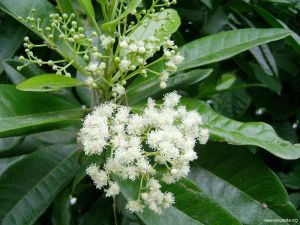
green and glossy, up to 15 cm (6 in) long. It has small white flowers
appearing in mid summer followed by green berries that turn purple when
ripe.
Cultivation
Trees are planted about 10m (30 ft) apart, allowing room for a full
canopy of fruit-bearing branches. Fruit starts to develop after about five
years, and becomes full-bearing after twenty years.
It can be grown outdoors in the tropics and subtropics with normal garden
soil and watering. Smaller plants can be killed by frost, although larger
plants are more tolerant. It adapts well to container culture and can be
kept as a houseplant or in a greenhouse. The plant has separate sexes,
hence male and female plants must be kept in proximity in order to allow
fruits to develop.
Allspice is most commonly sold as whole dried fruits or as a powder.
Whole dried allspice will keep indefinitely when kept out of light in
airtight jars. The whole fruits have a longer shelf-life than the powdered
product and produce a more aromatic product when freshly ground before
use. The ground spice loses flavour quickly.
Parts Used
The fruit is picked when it is green and unripe, traditionally they are
then sun dried. When dry they are brown and look like large brown
peppercorns. Unripe berries are harvested and sun dried until the seeds in
them rattle. They vary in size between 4 to 7 mm (1/8 - 1/4 in) in
diameter and are dark brown with wrinkled skins. The outer case contains
two dark, hard kidney-shaped seeds. Allspice is available whole or ground.
Medicinal Properties
- Allspice provides relief for digestive problems because the volatile
oil contains Eugenol, a weak antimicrobial agent.
- It is also carminative in nature as it also contains an oil
rubefacient, meaning that it irritates the skin and expands the blood
vessels, increasing the flow of blood to make the skin feel warmer.
- The tannins in allspice provide a mild anesthetic that, with its
warming effect, make it a popular home remedy for arthritis and sore
muscles, used either as a poultice or in hot baths.
Culinary Uses
- Allspice can be used as a substitute, measure, for cinnamon, cloves
or nutmeg.
- Jerked meats like pork, chicken and kid reflect the Spanish/Jamaican
background of Allspice.
- It is a particularly popular spice in European cooking, an important
ingredient in many marinades, pickling and mulling spices.
- Many pâtés, terrines, smoked and canned meats include
allspice. It is also used in liqueurs.
Other names
| English |
: |
Spice, Jamaica Pepper, Clove Pepper, Myrtle Pepper,
Pimenta, Pimento |
| French |
: |
pimenta, tout-épice |
| German |
: |
Jamikapfefer |
| Indian |
: |
kabab cheene, seetful |
| Italian |
: |
pimento |
| Spanish |
: |
pimiento de Jamaica |