Amaranth
(Botanical Name : Amaranth Caudatus))
Classification
- Kingdom :Plantae
- Division :Magnoliophyta
- Class :Magnoliopsida
- Order :Caryophyllales
- Family :Amaranthaceae
- Sub family :Amaranthoideae
- Genus :Amaranthus
Plant Description
Amaranth foliage is used as vegetable and as animal food in tropics and
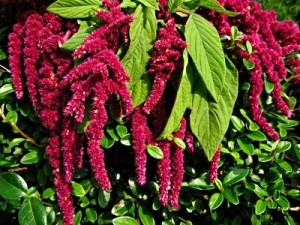
subtropics. It is an annual bushy plant that grows 5 to 7 feet with broad
leaves and a showy flower head of small red clover like flower which are
profuse and constitutes feathery plumes.
The seed head resembles corn tassels but are bushier. The seeds are small
and lens shaped which are creamy to golden tan colour that is sprinkled
with dark coloured seeds.
Other Names
- ARABIC: Awaiting feedback ,Awaiting feedback ,Awaiting feedback.
- CHINESE : Hong xian cai (Taiwan), Wei sui xian, Lao qiang gu, Lao
qiang ke (Taiwan).
- DANISH: Rævehale-amarant.
- ENGLISH: Foxtail amaranth, Inca wheat, Love-lies-bleeding
- FINNISH: Punarevonhäntä.
- FRENCH: Amarante caudée, Amarante queue-de-renard.
- GERMAN: Fuchsschwanz, Gartenfuchsschwanz, Inkaweizen.
- HINDI: Raamadaanaa (Ramdana). ITALIAN: Amaranto coda rossa.
- JAPANESE :Himo geitou, Sennin koku. MALAY: Bayam ekor kucing
(Indonesia), Bayam selaseh.
- POLISH: Szarlat zwisly. PORTUGUESE: Cauda-de-raposa, Moncos-de-Peru.
- RUSSIAN: Shiritsa khvostataia.
- SINHALESE: Rana tampala.
- SLOVENIAN: Repati šcir.
- SPANISH : Achita (Peru), Achis (Peru), Amaranto, Bledo francés,
Coimi (Peru), Cola de zorro, Coyo, Cuipa (Peru), Jataco, Kiwicha (Peru),
Moco de pavo, Qamaya, Quilete, Quinoa del valle (Argentina), Sangoracha,
Trigo del Inca.
- SWEDISH: Rävsvans. THAI: Phak khom bai daeng.
- VIETNAMESE: D?n duôi ng?n, D?n duôi ch?n?
