
Spice Description
Cumin is the seed of a small umbelliferous plant. The seeds come as
paired or separate carpels, and are 3-6mm (1/8-1/4 in) long. They have a
striped pattern of nine ridges and oil canals, and are hairy, brownish in
colour, boat-shaped, tapering at each extremity, with tiny stalks
attached. They are available dried, or ground to a brownish-green powder.
It has a spicy-sweet aroma with pungent, powerful, sharp and slightly
bitter flavour.
History
It is native to the shores of the Mediterranean Sea and Upper Egypt.
Cumin has been grown and used as a spice since ancient times. It was
originally cultivated in Iran and the Mediterranean region.
It was also known in ancient Greece and Rome. The Greeks kept cumin at
the dining table in its own container (much as pepper is frequently kept
today), and this practice continues in Morocco. The spice is especially
associated with Morocco, where it is often smelt in the abundant street
cookery of the medina.
During medieval times, it was favored in Europe and Britain, but it seems
to have gradually lost favor in those places except in Spain during the
Middle Ages but is more widely used again today; it was introduced to the
Americas by Spanish colonists.
Cumin seeds are used as a spice for their distinctive aroma, popular in
North African, Middle Eastern, western Chinese, Indian and Mexican
cuisine.
Primary cultivation of cumin is in Europe, Asia, the Middle East, and
North Africa with India and Iran as the largest cumin exporters. It is now
mostly grown in Iran, Uzbekistan, Tajikistan, Turkey, Morocco, Egypt,
India, Syria, Mexico, and Chile.
Plant Description
Cinnamon is a herbaceous, glabrous annual plant of the parsley family.
It usually reaches 25 cm (10 in) (some varieties can be double this
height) somewhat angular and tends to droop under its own weight.
The leaves are 5-10 cm long, pinnate or bipinnate, with thread-like
leaflets. They are blue green in colour and are finely divided, generally
turned back at the ends. The upper leaves are nearly stalk less, but the
lower ones have longer leaf-stalks.
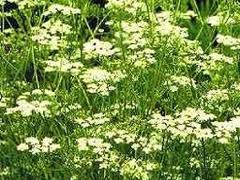
The flowers are small, white or pink, and borne in small stalked compound
umbels with only four to six rays, each of which are only about 1/3 inch
long, and bloom in June and July, being succeeded by fruit.
The fruit are oblong in shape, thicker in the middle, compressed
laterally about 5 inch long, containing a single seed. The seed is
uniformly elliptical and deeply furrowed.
Cultivation
Cultivation of cumin requires a long, hot summer with 3-4 months with
daytime temperatures around 30 °C; it is drought tolerant, and is
mostly grown in mediterranean climates. A hot climate is preferred, but it
can be grown in cooler regions if started under glass in spring.
It is grown from seed sown in spring, and needs a fertile, well-drained
soil. A sandy soil is best; when the seedlings have hardened, transplant
carefully to a sunny aspect, planting out 15cm apart. Seed regularly.
The reported life zone of cumin is 9 to 26 degrees centigrade with an
annual precipitation of 0.3 to 2.7 meters and a soil pH of 4.5 to 8.3.
The plants bloom in June and July. The seeds are normally ready four
months after planting. Cut the plants when the seeds turn to brown, thresh
and dry like the other Umbelliferae.
They should be sown in small pots, filled with light soil and plunged
into a very moderate hot bed to bring up the plants. Keep clean of weeds
and the plants will flower very well and will probably perfect their seeds
if the season should be warm and favourable.
The plants are threshed when the fruit is ripe and the 'seeds' are dried.
Parts Used
The valued portion of the plant is the dried fruit called cumin seed,
which is esteemed as a condiment.
Preparation & Storage
It should be kept in air tight containers and should be used in the hot
oil or can be consumed raw in curd, tomatoes etc. The seeds can be lightly
roasted before being used whole or ground to bring out the aroma.
Cumin may also be pounded with other spices in mixtures such as curry
powder. Ground cumin must be kept airtight, to retain its pungency. This
spice should be used with restraint - it can exclude all the other
flavours in a dish. Less than a teaspoon of it will flavour a meal for
four.
Chemical constituents
The strong aromatic smell and warm, bitter taste of Cumin fruits are due
to the presence of a volatile oil, cumin aldehyde, which exists in the
proportion 2.5 to 4%. It is separated by distillation of the fruit with
water. It is limpid and pale yellow in colour, and is mainly a mixture of
cymol or cymene and cuminic aldehyde, or cyminol, which is its chief
constituent.
The characteristic odor of cumin is caused primarily by aldehydes that
are present in the oil.
Culinary Uses
- Cumin is used mainly where highly spiced foods are preferred.
- It features in Indian, Eastern, Middle Eastern, Mexican, Portuguese
and Spanish cookery.
- It is an ingredient of most curry powders and many savoury spice
mixtures, and is used in stews, grills - especially lamb - and chicken
dishes.
- Cumin is a critical ingredient of chili powder, and is found in
achiote blends, adobos, garam masala, curry powder, and baharat.
- Cumin is used as a flavoring agent in cheeses, pickles, sausages,
soups, stews, stuffing, rice and bean dishes, and liqueurs.
- It gives bite to plain rice, and to beans and cakes.
- Small amounts can be usefully used in aubergine and kidney bean
dishes.
- Oil of cumin is used in fragrances.
- Cumin is frequently used in Mexican dishes such as chili con carne,
enchiladas with chili sauce and hot tamales.
- In the Middle East, it is a familiar spice for fish dishes, grills
and stews and flavours couscous - semolina steamed over meat and
vegetables, the national dish of Morocco.
- A refreshing and appetizing Indian drink, zeera pani is made from
cumin and tamarind water.
Medicinal Uses
- As a medicinal plant, cumin has been utilized as a stimulant,
antispasmodic, carminative and sedative.
- Cumin oil has been reported to have antibacterial activity.
- It is used as a corrective for the flatulency of languid digestion
and as a remedy for colic and dyspeptic headache.
- It was recommended as a cure for stitches and pains in the side
caused by the sluggish congestion of indolent parts.
- Its principal employment is in veterinary medicine. Bay-salt and
Cumin-seeds mixed, is a universal remedy for the diseases of pigeons,
especially scabby backs and breasts.
Other Names
- French: cumin
- German: Kreuzkümmel, Romische Kümmel
- Italian: cumino
- Spanish: comino
- Dutch: Komijn
- Portuguese: Cominho
- Russian: Kmin
- Chinese: Machin
- Arabic: kammun, kemouyn
- Swedish: Spiskummin
- Indian: jeera, jeraka, jira, zeera, zira,
- Indonesian: (d)jinten
- Malay: jintan puteh
- Sinhalese: cheeregum, jeera, su(du)duru