
Spices and Medicinal Herbs
A complete guide to vegetables, spices & herbs
Vegetables

What are vegetables?

Classification of vegetables
Leafy Vegetables
Fruit and Flower Vegetables
Root, Tuber and Bulb Vegetables
Bulbs
Tubers
Roots
Podded Vegetables
Seaweed Vegetables
Fungi Vegetables

Spices
Herbs

What are herbs?

Classification of herbs
Annual Herbs
Biennial Herbs
Perennial Herbs


Home :: About Us :: Contact US

Vegetable : Garlic

(Botanical Name : Allium sativum)

Classification

"

History

Garlic is believed to be the native of Central Asia, the center of diversity ranging from the Himalayas to Turkestan and has been cultivated for more than 5000 years.

It was worshipped by the Egyptians and fed to workers building the Great Pyramid at Gaza, about 2600 BC. Greek athletes ate it to build their strength. It was largely consumed by the ancient Greek and Roman soldiers, sailors and rural classes and by the African peasantry.

Garlic came to the Western Hemisphere with some of the first European explorers, and its use spread rapidly. In the United States it was first cultivated in New Orleans by French settlers. Missionaries brought it to California, where it is grown today. Garlic was rare in traditional English cuisine.

"

Plant Description

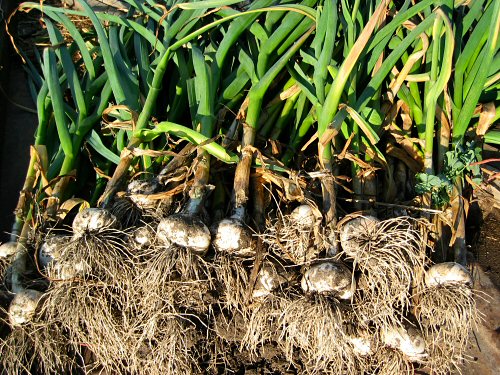
It is a perennial plant which rises to a height of 1-2 ft (0.3-0.6 m) tall at maturity. The foliage comprises a central stem 25 - 100 cm tall, with flat or keeled leaves 30 - 60 cm long and 2 - 3 cm broad.

The leaves are long, narrow and flat like grass, with a crease down the middle and are held erect in two opposite ranks.

The flowers are placed at the end of a stalk rising direct from the bulb and are whitish, grouped together in a globular head and are surrounded by a papery basal spathe; each flower is white, pink or purple, with six tepals 3 - 5 millimetres long. The flowers are commonly abortive and rarely produce any seeds.

A garlic head is generally four to eight centimeters in diameter, white to pinkish or purple, and is composed of numerous (8 - 25) discrete bulbs. The bulb is of a compound nature, consisting of numerous bulblets, known technically as 'cloves,' grouped together between the membranous scales and enclosed within a whitish skin, which holds them as in a sac.
Cultivation

It does not grow in the wild, and is thought to have arisen in cultivation, probably descended from the species Allium longicuspis, which grows wild in south-western Asia.

The soil may be sandy, loam or clay, though Garlic flourishes best in a rich, moist, sandy soil. Garlic beds should be in a sunny spot. They must be kept thoroughly free from weeds.

The domesticated garlic plant does not produce seeds, but is grown from bulbs. Divide the bulbs into their component 'cloves' - each fair-sized bulb will divide into ten or twelve cloves.

Garlic can tolerate periods without rain, but best results come from plants that receive regular watering. Garlic is best planted in the fall and allowed to over winter in the ground, to be harvested the following summer. In mild climates garlic will grow all winter; in cold climates areas, it will go dormant in the winter, and should be mulched.

When planted early in the spring, in February or March, the bulbs should be ready for lifting in August, when the leaves will be beginning to wither. Should the summer have been wet and cold, they may probably not be ready till nearly the middle of September.

Parts Used

The bulb is the only edible part.

When a cell of a garlic clove is broken by chopping, chewing, or crushing, enzymes stored in cell vacuoles trigger the breakdown of several sulfur-containing compounds stored in the cell fluids. The resultant compounds are responsible for the sharp or hot taste and strong smell of garlic.

When eaten in quantity, garlic may be strongly evident in the diner's sweat and breath the following day. This is because garlic's strong smelling sulfur compounds are metabolized forming allyl methyl sulfide. Allyl methyl sulfide (AMS) cannot be digested and is passed into the blood. It is carried to the lungs and the skin where it is excreted. Since digestion takes several hours, and release of AMS several hours more, the effect of eating garlic may be present for a long time.

"

Chemical constituents

The active properties of Garlic depend on a pungent, volatile, essential oil. Garlic contains 0.1-0.36% of a volatile oil composed of sulfur-containing compounds: allicin, diallyl disulfide, diallyl trisulfide, and others. The pecular penetrating odour of Garlic is due to this intensely smelling sulphuret of allyl.

Other constituents of garlic include: alliin (S-allyl-L-cysteine sulfoxide), S-methyl- L-cysteine sulfoxide, protein (16.8%, dry weight basis), high concentrations of trace minerals (particularly selenium), vitamins, glucosinolates, and enzymes (alliinase, peroxidase, and myrosinase).1, 2 Allicin is mainly responsible for garlic’s pungent odor. It is formed by the action of the enzyme alliinase on the compound alliin. The essential oil of garlic yields approximately 60% of its weight in allicin after exposure to alliinase.

The components of Garlic include Calcium, Folate, Iron, Magnesium, Manganese, Phosphorus, Potassium, and Zinc.

The Vitamins present in it are Vitamin B1, B2, B3, and C.

"

Culinary Uses

Medicinal Uses

Precautions

"

Other Names

"