
Spice Description
Cinnamon is the dried inner bark of various evergreen trees belonging to
the genus Cinnamomum. It has a warm and aromatic flavour and fragrance is
sweet and woody in both ground and stick forms. When distilled it only
gives a very small quantity of oil, with a delicious flavour. The best
varieties are pale and parchment-like in appearance.
The commercial Cinnamon bark is the dried inner bark of the shoots. Both
the bark and leaves are aromatic.
History
True Cinnamon is native to Sri Lanka. The Cinnamon used in North America
is from the cassia tree which is grown in Vietnam, China, Indonesia, and
Central America.
Cinnamon has been popular since ancient times. Egyptians imported it from
China in 2000 BC. In the Middle Ages, the source of cinnamon was a mystery
to the western world. Arab traders brought the spice via overland trade
routes to Alexandria in Egypt, where it was bought by Venetian traders
from Italy who held a monopoly on the spice trade in Europe.
Portuguese traders finally discovered Ceylon (Sri Lanka) at the end of the
fifteenth century, and restructured the traditional production of
cinnamon. The Dutch captured Sri Lanka in 1636 and established a system of
cultivation that exists to this day.
In ancient Egypt cinnamon was used medicinally and as a flavoring for
beverages. It was also used in embalming, where body cavities were filled
with spiced preservatives. In the ancient world cinnamon was more precious
than gold.
This is not too surprising though, as in Egypt the abundance of gold made
it a fairly common ornamental metal. It was commonly used on funeral pyres
in Rome. Nero, emperor of Rome in the first century AD, burned a years
supply of cinnamon on his wifes funeral pyre an extravagant
gesture meant to signify the depth of his loss.
It also grows plentifully in Malabar, Cochin-China, Sumatra and Eastern
Islands. It is also been cultivated in the Brazils, Mauritius, India,
Jamaica, etc.
Plant Description
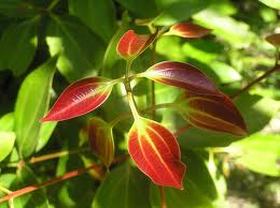
Cinnamon is from a tropical evergreen tree of the laurel family growing
up to 7m (56 ft) in its wild state. It has thick scabrous bark, strong
branches, young shoots speckled greeny orange.
The bark is smooth and yellowish.
The leaves are ovate, petiolate, deeply veined leaves that are dark green
on top, lighter green underneath. They become leathery when mature, upper
side shiny green, underside lighter. They when bruised smell spicy and
have a hot taste.
The flowers are yellowish-white with a disagreeable odour that bears dark
purple berries.
The fruit is an oval berry like an acorn in its receptacle, is bluish when
ripe with white spots on it, bigger than a blackberry.
Cultivation
Cinnamon is now largely cultivated. It grows best in almost pure sand,
requiring only 1 per cent of vegetable substance; it prefers a sheltered
place, constant rain, heat and equal temperature. It prefers a hot, wet
tropical climate at a low altitude.
The bark is harvested twice a year, starting when the trees are about
three years old, one year after pruning. Cinnamon is always harvested
immediately after each of the two rainy seasons, when the rain-soaked bark
can be more easily stripped from the trees.
Cultivated plantations grow trees as small bushes, no taller than 3 m (10
ft), as the stems are continually cut back to produce new stems for bark.
The outer bark, cork and the pithy inner lining are scraped off and the
remaining bark is left to dry completely, when it curls and rolls into
quills. Several are rolled together to produce a compact final product,
which is then cut into uniform lengths and graded according to thickness,
aroma and appearance.
Parts Used
The part of the plant used is the bark.
Preparation & Storage
If the cinnamon is kept in whole quills will keep their flavour
indefinitely. But it is difficult to grind so powdered variety will be
preferred.
The powdered cinnamon loses flavour quickly, and kept away from light in
airtight containers.
Chemical constituents
The primary chemical constituents of this herb include cinnamaldehyde,
gum, tannin, mannitol, coumarins, and essential oils (aldehydes, eugenol,
pinene).
The essential oil of this herb is a potent antibacterial, anti-fungal, and
uterine stimulant. The various terpenoids found in the volatile oil are
believed to account for Cinnamons medicinal effects.
Culinary Uses
- It is the most common baking spice.
- Cinnamon is used more in dessert dishes. It is commonly used in cakes
and other baked goods, milk and rice puddings, chocolate dishes and
fruit desserts, particularly apples and pears.
- It is common in many Middle Eastern and North African dishes, in
flavouring lamb tagines or stuffed aubergines.
- In American cooking, Cinnamon is often paired with apples and used in
other fruit and cereal dishes.
- Stick Cinnamon is used in pickling and for flavoring hot beverages.
- It is used in curries and pilaus and in garam masala.
- It may be used to spice mulled wines, creams and syrups.
- The largest importer of Sri Lankan cinnamon is Mexico, where it is
drunk with coffee and chocolate and brewed as a tea.
Medicinal Uses
- Cinnamon is carminative, astringent, stimulant, antiseptic.
- It is more powerful as a local than as a general stimulant.
- It stops vomiting, relieves flatulence, and given with chalk and
astringents is useful for diarrhoea and haemorrhage of the womb.
- Because of its mild astringency, it is particularly useful in
infantile diarrhea.
- Recent studies have determined that consuming as little as one-half
teaspoon of Cinnamon each day may reduce blood sugar, cholesterol, and
triglyceride levels by as much as 20% in Type II diabetes patients.
- It is used to treat nausea and flatulence.
- Cinnamon is a great remedy for people with cold feet and hands,
especially at night.
- The cinnamaldehyde component is hypotensive and spasmolytic, and
increases peripheral blood flow.
Other Names
- Ceylon: Cinnamon, True Cinnamon
- French: Cannelle
- German: Ceylonzimt, Kaneel
- Italian: Cannella
- Spanish: Canela
- Chinese: Yook gway
- Indian: Dal-chini, darchini, dhall cheene
- Sinhalese: Kurundu