
Basil is also known as Albahaca, St. Joseph's Wort, and Sweet Basil.
It is native to tropical Asia and central Africa. Both Bush and Garden
Basil are natives of India, from whence it was introduced in 1573.
Holy Basil, also called 'Thulsi' or 'Tulsi', is highly revered in
Hinduism and also has religious significance in the Greek Orthodox Church,
where it is used to prepare holy water.
The word basil comes from the Greek , meaning "king", as it is
believed to have grown above the spot where St. Constantine and Helen
discovered the Holy Cross.
It is cultivated extensively in France, Egypt, Hungary, Indonesia,
Morocco, and the United States (Arizona, California, New Mexico,
NorthCarolina), Greece and Israel.
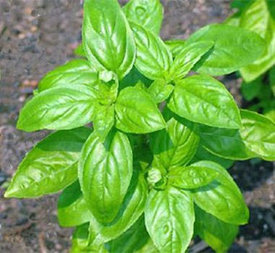
It is a tender low-growing herb. It grows to between 20 - 60 cm tall,
with opposite, light green, silky leaves one and a half to five
centimetres long and one to three centimetres broad.
It is a hairy, labiate plant with the stem obtusely quadrangular.
The flowers are labiate which are white in colour, are present in whorls
in the axils of the leaves, the calyx with the upper lobe rounded and
spreading.
The leaves, grayish-green beneath and dotted with dark oil cells, are
opposite, 1 inch long and 1/3 inch broad, stalked and peculiarly smooth,
soft and cool to the touch, and if slightly bruised, it exhales a
delightful scent of cloves.
There are several varieties, differing in the size, shape, odour and
colour of the leaves. The Common Basil has very dark green leaves, the
curled-leaved has short spikes of flowers, the narrow-leaved smells like
Fennel, another has a scent of citron and another a tarragon scent, one
species has leaves of three colours, and another 'studded' leaves.
They are easy to grow but are very susceptible to cold weather. It
thrives best in hot weather. They should be planted in late spring after
all danger of frost is past. To produce high quality basil, grow it in
full sun in warm, well-drained soil. Raised beds are highly recommended
because they promote good drainage and warm quickly in the spring.
Basil may be cultivated either as a field-grown crop or in a greenhouse.
It can be propagated using seeds, cuttings or transplants, seeding or
transplanting to the field once seedlings are more advanced.
Germination can occur in 5 to 7 days, but will take longer under cool
conditions. Place plants outside12-15 inches apart. A light sand to silt
loam with a pH of 6.4 is best. The tender herbaceous annual, which is
susceptible to frost and cold-temperature injury, develops best under long
days, in full sun, and well-drained soils.
Basil will not tolerate moisture stress. Water needs to be applied
regularly throughout the growing season to maintain constant growth.
The whole herb, both fresh and dried.
Sweet basil contains a volatile oil (about 1%), which consists principally of linalool and methyl chavicol, along with small quantities of methyl cinnamate, cineole, and other terpenes. Relatively large quantities and bisabolene, camphor, cryophyllene, geraniol, and ocimene in smaller quantities influencing taste and action in the body.
| English | : | basil |
| French | : | basilic |
| German | : | basilikum, basilienkraut |
| Indian | : | tulsi |
| Italian | : | basilico |
| Spanish | : | albahaca |