Herb : Bitter melon
(Botanical name: Momordica Charantia)
Classification
- Kingdom- Plantae
- Division- Magnoliophyta
- Class- Magnoliopsida
- Order- Cucurbitales
- Family- Cucurbitaceae
- Genus- Momordica
- Species- M. charantia
History
Bitter melon is a tropical and sub-tropical vine which is grown for its
fruit that is extremely bitter and used as a vegetable.
The plant is a climbing perennial and bears a fruit which is most bitter
among the vegetables.
Though a very bitter vegetable it is popularly used in India and other
tropical countries like china, Thailand, east Africa and Asia.
Plant Description
Bitter melon is an herbaceous plant; tendril-bearing leaves that are 2-4
cm with 3-7 deeply separated lobes.
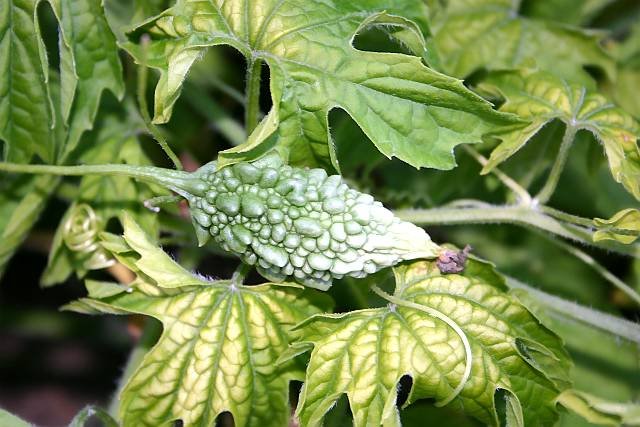
The plant bears each male and female separate yellow flower. The fruit is
oblong, with a distinct warty exterior look.
The fruit is dark green and hollow from inside with cross section and
relatively thin layer of flesh surrounding a central seed cavity filled
large flat seeds.
Cultivation
Bitter gourd cultivation requires rich moist soil with full or partial
sunlight.
Avoid this plant in cold areas and it is frost sensitive and doesn't
require frequent watering.
Bitter melon is widely cultivated in India and other subcontinents,
china, Asia, Africa and Caribbean.
Parts Used
The fruit is used as a vegetable and medicine.
Constituents
Bitter melon is rich in carbohydrates, fats, protein, water, vitamin A,
thiamine, riboflavin, niacin, vitamin B6, folate, vitamin B12, vitamin E,
C, K, calcium, iron, magnesium, phosphorus, potassium, sodium and zinc.
Culinary uses
- In India, south Asia and West Indies bitter gourd is often cooked
with potatoes.
- In other parts it is stuffed with spices and tied with thread so that
it can be fried in oil.
- It is also deep fried like pakoras.
- Bitter melon juice is frequently drunk by people as a medicine.
- In Indonesia it is prepared with milk, stir fry or steamed. Different
countries prepare different dishes with bitter gourd.
Medicinal uses
- Bitter gourd is considered as very good herbal medicine in ayurveda.
It has been used in traditional medicines since a long time.
- It helps in proper digestion, dyspepsia and constipation.
- It is believed to be an effective medicine in diabetes and also works
as anti-flatulent.
- Reports have shown that bitter melon is useful in preventing and
treating malaria.
- It is also effective in treating HIV and various cancers, especially
breast cancer.
- It also works as an abortifacient herb which induces abortion, so in
pregnancy it must be avoided.
Names
- English-: Balsam pear, Leprosy pear, Leprosy gourd, Bitter gourd,
Bitter cucumber
- Italian-: Pomo meraviglia, Momordica amara
- German-: Balsambirne, Bittergurke, Balsamgurke.
- Danish-: Balsamagurk, Balsamaeble
- Russian-: Indiiskoe zheleznoe derevo, Mezua zheleznaia, Mezuia
zheleznaia, Nagakeshara (from Hindi), Zheleznoe derevo.
- Burmese-: Kyethinkhathee
- Chinese- : Ku gua (Cantonese Fu gwa, Foo gwa, Foo kwa), Jin li zhi,
Lai pu tao, Ku gua ye, Ku gua ye (Cantonese Foo gwa yip for leaves), Kor
kuey (Hokkien - Singapore).
- Finnish-: Karvaskurkku.
- Dutch- : Balsempeer
- French-: Margose (Réunion, Mauritius Islands), Margose amère,
Momordique amère, Concombre amer, Concombre africain.
- Khmer-: Mreah.
- Laotin-: Bai maha, Haix, S'aix.
- Hindi-: Karela, Kerela, Tita kerala
- Japnese-: Niga uri, Nigai uri, Tsuru reishi, Tsuru reishi.
- Malay-: Peria, Daun peria (leaves), Peria laut, Peria katak, Paré
(Java), Peparé (Java), Paria (Indonesia)..
- Nepalese-: Karelaa, Tito karelaa
- Sinhalese-: Karavila, Karawila, Pakal, Pavakai
- Spanish-: Bálsamo, Calabaza africana, Cundeamor, Momordica
amarga, Pepino amargo.
- Swedish-: Bittergurka.
- Tamil-: Pava aki..
- Tagalog-: Ampalaya.
- Thai-: Maha, Mara, Phakha
- Vietnamese-: La khoqua
- Visayan-: Palia.
